
Few things in life are as rewarding as sharing part of it with a happy, well-adjusted, predictable dog. Temperament is the term used to define an animal’s behavior – his or her basic nature. Temperament predicts how well the dog will respond to any given circumstance. It is the temperament that determines if a dog grows to become a sweet, affectionate, confident animal, or if he is a suspicious, nervous, easily agitated, even aggressive dog. Before you add a Maltipoo to your family, it is very important to understand temperament and the factors that contribute to your dog’s behavior as an adult.
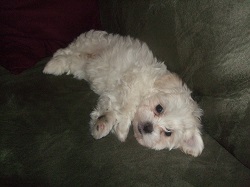 Nature or Nurture – Forming the Maltipoo Personality
Experts in the field of canine health and training will divide on the subject of temperament. Most will agree some part of a dog’s temperament is inherited from the sire and dam. How much of the temperament is contributed by genetics (nature) and to what extent environmental issues (nurture) shape a dog’s personality is where the debate begins. It may be assumed that if a puppy’s mother is aggressive, nervous, and skittish your puppy will grow up to be an adult dog withsimilar personality traits.
While a Maltipoo’s personality is shaped somewhat by the parents, a puppy that is not socialized and handled, or that is abused, malnourished, and otherwise mistreated will react by developing negative personality disorders. Training a Maltipoo – or any pet – is as critical as evaluating the genetic predisposition for good behavior traits.
Contributions of the Maltipoo’s Parents
Maltipoo characteristics begin with the parents. Maltipoos are hybrid dogs – they are usually developed from breeding a Maltese with a Poodle. The start to evaluating the potential for a Maltipoo adult personality begins with understanding the breed traits of the Malti (Maltese) and the poo (Poodle).
According to breeder standards, the small, hardy Maltese is a playful, spirited, happy dog. A well-bred Maltese should be confident, affectionate and loyal. The bond with their master makes the Maltese protective and quick to sound the alarm if he perceives stranger danger. The Maltese should get along well with other animals, people and children. They are susceptible to develop small dog syndrome, making them suspicious, jealous, yappy, and wary little dogs.
The Poodle part of the Maltipoo personality provides a healthy dose of intelligence and playful enthusiasm. Even the prediction of the Maltipoo’s size is determined by the Poodle parent – Poodles come in a variety of sizes from tiny teacups to big standard Poodles. It should be noted that most Maltipoo puppies are bred from the miniature or smaller versions of the Poodle breed. Poodles were developed for the purpose of hunting fowl. That adventurous spirit carries in the breed today. Poodles are very smart, athletic, responsive, and loyal to their humans. They are easy to train and they tend to get along well with other animals and people – including children – if properly socialized. They are considered sensitive dogs given to shy behavior and can become suspicious and wary around strangers or people they do not trust.
It may be difficult to determine which of the parent Maltese/Poodle characteristics pass more strongly to impress the Maltipoo personality. Determining a puppy’s disposition and temperament is not as easy as predicting the Maltipoo size based on the evaluation of the parent’s apparent gene pool. Still, there are personality tests developed and utilized by canine behaviorists and breeders to assess the possible aptitude for a dog’s personality.
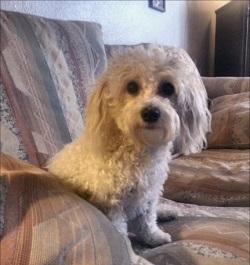 Maltipoo Temperament Tests
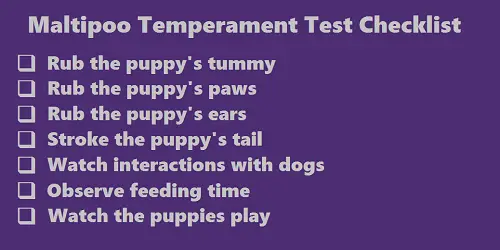
A personality evaluation provides a good basis for determining the temperament of a dog. Most adoption shelters use some form of temperament test before offering the animal to be adopted into a forever home. Even small puppies can be evaluated for potential behavior characteristics. Simple guidelines for the person looking for a good, solid puppy include the following steps:
- Turn the puppy on her back and rub her tummy. Watch for signs of annoyance or serious objections to being held in the submissive position. If a puppy will not be calmed on his back and subject to the tummy rub it may indicate a dominant/alpha
- With the puppy on the ground, hold her front paws between your finger and thumb, gently rubbing the paws. Move to the two back paws. The puppy should permit touching and rubbing the paws without growling or acting annoyed.
- Gently rub the puppy’s ears. He should actually enjoy the exercise and not object.
- Stroke the puppy’s tail. Tug lightly and watch for signs of aggression.
- Watch the puppy’s interaction with litter mates and other dogs. Is her posture confident, playful, and proud, or does she tend to hunker, hide or cower. A confident dog may be more dominant as they mature. A shy dog will probably be more submissive as an adult.
- Observe feeding time. If a puppy is pushy and seems to be over-anxious to get to the food, he will most likely be a dominant dog and possibly become food aggressive if not properly trained.
- Puppies at play also provide a good indication of personality types. A puppy that sits back and watches the action tends to be more submissive. The leaders of a litter are more active, bossy, and usually in the middle of a fray.
 Bear in mind that you are watching a group of baby animals. They are all adorable. They will nibble, growl, scratch, and be overly enthusiastic, all of which are considered normal puppy behavior, so be patient as you administer the guidelines listed. You are evaluating the abnormal tendencies: obvious annoyance, inappropriate growling, and extreme shyness.
All puppies have the ability to become great companion pets – they also have the potential to grow into dangerous animals capable of a lot of harm. The real test of temperament is in the training.
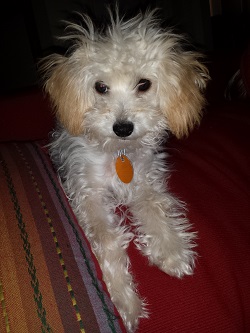 Training a Maltipoo
The checklist for finding your perfect Maltipoo must include the temperament. You should know your capabilities and commitment as the pet owner – the alpha, the pack leader. If you are not an experienced pet owner or if you do not have the time and interest in working with a dominant dog, choose a more submissive puppy from the litter. Like humans, each litter will produce puppies with different personalities.
- Alpha dogs – dogs that clearly need to be in the lead and have trouble following
- Middle dogs – willing to be led but will step up and take control if necessary
- Submissive dogs – naturally fall into the practice of following
The Maltipoo training program you plan will depend on the type of Maltipoo personality you are working with.
Alpha dogs are natural leaders, but unless you are planning a pack for sledding you do not want to encourage the alpha personality. An alpha dog can become overprotective to the point of aggression toward other dogs and humans. They are not necessarily mean; they are just exercising the role of pack protector. It is a survival instinct. In the case of an alpha dog, the adult Maltipoo size means nothing. The human must establish the leader role with an alpha dog. Lacking proper training, the tiniest pooch can rule the house if he or she has the mindset, tendency, and opportunity to do so.
Middle dogs may be considered easiest to train. They require consistent handling, daily exercise, and routines to prevent boredom. It is essential that the human is looked to as the leader of the pack. Middle dogs will test the limits to determine their role in the pack. The lack of training and strong human leadership can lead to anxiety and confusion for the middle dog, leading to chewing, barking, and destruction of property.
Submissive dogs may appear timid, cautious and nervous. They need a confident, consistent leader, and that leader must be the human. A submissive full-grown Maltipoo may be easily upset or irritated and resort to excessive barking, chewing, inappropriate urinating, and hiding. Training develops a sense of safety for the naturally worried little Maltipoo and prevents the development of fear aggressions and other behavioral issues.
Regardless of the estimation of your Maltipoo’s temperament, all dogs are capable of learning basic commands. It is the human’s job to develop the traits and train to keep their pet physically and mentally fit. Basic tools that are proven to produce positive results include:
- Patience – Your Maltipoo is not simply learning to repeat an action on command; she is learning a new language. Be patient with the process. Try to plan a time to train when you are both relaxed and focused. Choose a quiet, safe location for your training sessions. Practice clear, easy to understand cues. Start each session with a review of leaned “tricks,” before teaching a new command. Repeat until the dog can replicate the command. If you or your dog becomes frustrated or tired, it is time to stop and begin again when refreshed.
- Consistency – Prepare and know your REALISTIC expectations before you begin. Dogs learn from association. The trainer must deliver a consistent message. Do not begin training with a clicker, then change to voice or hand commands. Initally, even rewards should be consistent – the same highly desirable treat. Eventually your Maltipoo will understand the training routine. As her confidence and skills expand, add more of a variety of treats and distractions to the training routine.
- Timing – Your Maltipoo’s association with an act reinforces his behavior. Have a reward ready for delivery immediately at the moment he accomplishes a command. A reward delivered too early creates a distraction and he will learn to bypass the command and seek the treat – rewarding too late will confuse his reinforcement. He must understand what he did right to earn the praise.
- Motivation – Highly desirable treats make it or break it in the canine training arena. Determine what motivates your Maltipoo to achieve. Mix the rewards up until you discover the trigger that produces the best results.
- K-I-S-S (Keep It Simple, Stupid)- Keep the training and commands short. Introducing too many commands early in the learning curve will be confusing and frustrating for the dog and the trainer.
- Pleasure – Nothing builds the human/animal bond like an established training protocol. The most effective training should be fun for both of you.
Plan your dog’s training routine just as you plan feeding and exercise schedules. From the time your Maltipoo is a baby through adulthood and to his/her life as a senior, any dog will continue to learn and benefit from the proper motivation and communication tools.
No matter what your Maltipoo’s gene pool contributes to his or her overall personality, training will be the critical key to your dog’s ultimate health, happiness, and good life!